
NOVELLAS
This content is currently under development.

White Garden Dream
Arman Arian’s White Garden Dream is a surreal and philosophical novella that transports readers into a house-garden where the Amesha Spentas—the “Immortal Pure Ones” of Zoroastrian cosmology—gather in human form to confront the forces of Ahriman. Told in the first person, the story follows a weary young writer whose chance encounter with a mysterious stranger draws him into this timeless assembly. Over the course of one extraordinary night, he witnesses the eternal battle of light and darkness, gradually shedding disbelief and despair until he emerges transformed, bearing the responsibility of sharing what he has seen with the world.
Though only 88 pages, the novella distills the mythic vision that runs through Arian’s larger works, including its later development in the Patash Khowargar pentalogy. Drawing on Zoroastrian, Mithraic, Manichaean, and other ancient traditions, White Garden Dream reimagines Iranian myth in a vivid, accessible form for young adults and adults alike. With its blend of mystery, symbolic encounters, and philosophical depth, the book stands as a luminous gateway into Iran’s spiritual heritage, offering a narrative that is both rooted in antiquity and alive with contemporary meaning.
Dark Garden Nightmare
Arman Arian’s Dark Garden Nightmare is a landmark in Iranian young adult literature and one of the first serious works in the genre of dark fantasy. The novella follows a fourteen-year-old boy, the thirteenth child of his family, who grows up in a walled garden where all of his siblings have died before reaching the age of fifteen. As he approaches this threshold, he confronts not only the mystery of his family’s fate but also the hidden forces of fear, silence, and domination that govern his world. Told in the boy’s own voice, the story blends haunting realism with dreamlike encounters, suspense, and mythic undertones.
First published in Persian, the novella was later translated into English by Caroline Croskery and published by Candle and Fog Publishing (ISBN 978-1541361584). Suspenseful and visually rich, Dark Garden Nightmare pushes the boundaries of young adult storytelling, offering readers not just a chilling tale but also a reflection on awareness, freedom, and the courage to break cycles of fear.
The Book of Enchantment
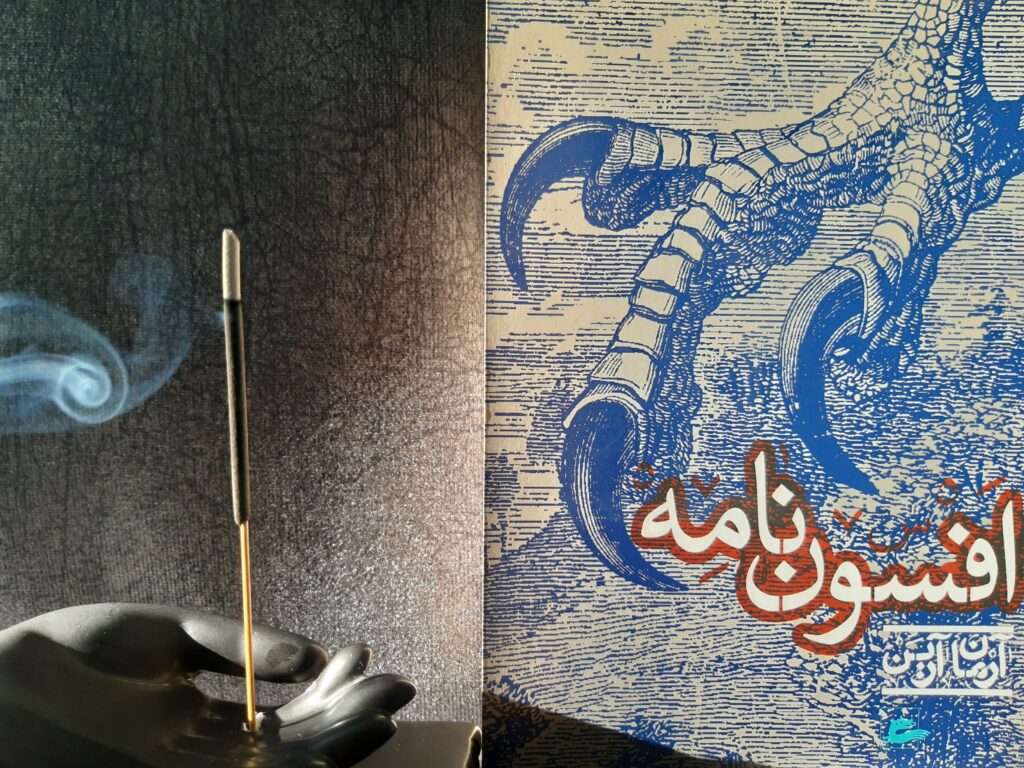
Arman Arian’s The Book of Enchantment is a thought-provoking novella that examines how language, ritual, and authority shape collective belief. Set in a storm-stricken village at the funeral of a revered figure, the story unfolds through the memories of his pupils and followers, gradually revealing darker truths about power, superstition, and the fragility of human judgment. Through its episodic, multi-voiced structure, the narrative keeps readers—especially young adults—poised between fascination and skepticism, inviting them to question not only what happens, but why it happens.
Blending the oral rhythms of Persian storytelling with concise, cinematic prose, The Book of Enchantment becomes both a tale and a “narrative laboratory” for exploring enchantment and counter-enchantment. Its themes echo the lessons of folklore, philosophy, and civic awareness: how authority can captivate, how rituals can unite and mislead, and how doubt and dialogue can break cycles of domination. More than a story of a village, Arian offers young readers a guide to critical literacy, showing that the courage to ask questions can itself be a liberating act.
Sepitmān: The Story of Zoroaster’s Life
In Sepitmān, Arman Arian retells the life of Zarathustra in the form of a compelling novella for young and adolescent readers. Beginning with a dramatic dialogue between Zarathustra and Ahriman at the age of thirty, the narrative then traces his journey from childhood to prophecy: his youthful search for truth, his exile by Mithra-worshippers, seven years of solitary reflection in nature, and ultimately his encounter with Ahura Mazda and proclamation of a new faith. Woven into the story are excerpts from the Gathas and other historical sources, making Sepitmān both a vivid narrative and a faithful introduction to one of history’s earliest spiritual revolutions.
More than a biographical tale, the novella illuminates Zarathustra as a philosopher, mystic, and moral teacher whose principles—free will, the law of Asha (Truth), good thoughts, good words, good deeds, and respect for nature—remain urgent for today’s world. Sepitmān offers readers a timeless story of perseverance and vision, one that bridges ancient heritage with contemporary concerns from moral ecology to active hope.
The Dark and Roshana
This content is currently under development.